The World Doesn’t Announce Its Turning Points
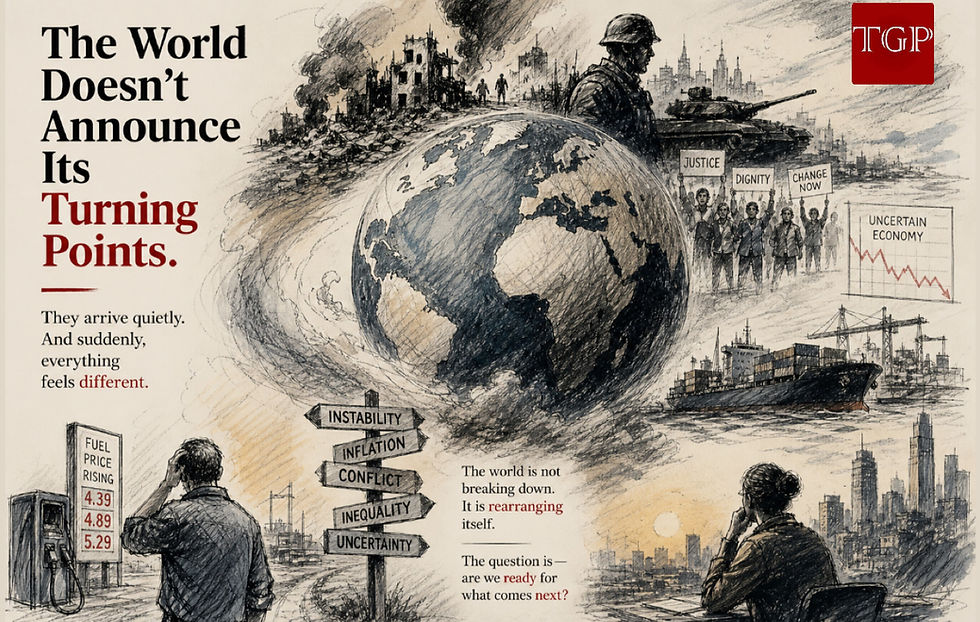
There is something quietly unsettling about the times we inhabit not because of a singular crisis, but because distance has dissolved into immediacy. A transport owner recalculates costs as fuel fluctuates, payments stall, and margins narrow; he is not tracking geopolitics, yet geopolitics is embedded in every figure before him. This is the defining condition of the present: the global no longer remains abstract but manifests directly in the everyday. Where world affairs once appeared bounded serious yet distant, disruptive yet episodic that continuity has thinned, giving way not to disorder, but to a more intricate and less legible reality.
This shift is not confined to isolated experiences; it is structural. Across societies, individuals who have adhered to established pathways education, discipline, employment now encounter deferred stability and uncertain returns on expectation. What was once a predictable social contract has become contingent, shaped by forces that operate beyond immediate visibility. These lived realities mirror transformations at the level of states, where alliances are increasingly fluid, decision-making cycles compressed, and outcomes less assured. Diplomacy persists, but with diminished permanence, adapting to a world defined less by long-term equilibrium and more by continuous recalibration.
At the systemic level, this moment reflects a broader reconfiguration rather than breakdown. Economies are restructuring in response to supply chain fragility and technological acceleration; energy systems are being reconsidered under the dual pressures of sustainability and security; and institutions, though strained, continue to adapt in order to retain relevance. Yet what distinguishes the present is not merely the pace of change, but the erosion of interpretive clarity. Traditional frameworks political, economic, and social no longer fully account for the overlapping and often contradictory patterns now shaping global behavior.
History, in this sense, is not announcing itself through rupture but through quiet realignment. The ground is shifting incrementally, even as perception remains anchored to earlier certainties. The critical question, therefore, is not whether instability is increasing, but whether stability itself is being redefined in ways that demand new modes of understanding. This moment is not an interruption in the trajectory of the global order; it is a transition into a more complex and continuously negotiated equilibrium.

Chief Editor Srishti Shankar Pandey

Comments